Introduction
This is one of those decisions that shapes everything about how your startup runs — the pace, the pressure, who you answer to. Some founders swear by bootstrapping a startup entirely on their own revenue, while others chase venture capital from day one. Neither is automatically right. I’ve seen both approaches work, and both fail, depending entirely on the type of business and what the founder actually wanted out of it.
What Bootstrapping Really Means
Quick answer: Bootstrapping a startup means growing your business using personal savings, revenue, and minimal external funding, giving you full control and ownership, but usually limiting how fast you can scale compared to venture-backed competitors.
It’s not just “not raising money” — it’s a genuine strategic choice that shapes how you prioritize spending, growth speed, and risk-taking.
What Venture Capital Actually Offers
VC funding provides significant capital upfront in exchange for equity, allowing faster hiring, marketing, and product development than bootstrapped growth typically allows.
- Access to large capital for aggressive growth
- Investor networks and mentorship, if the investors are genuinely helpful
- Pressure to scale quickly, since investors expect significant returns
- Loss of some control, since investors typically get board seats or voting rights
Comparing Control and Ownership
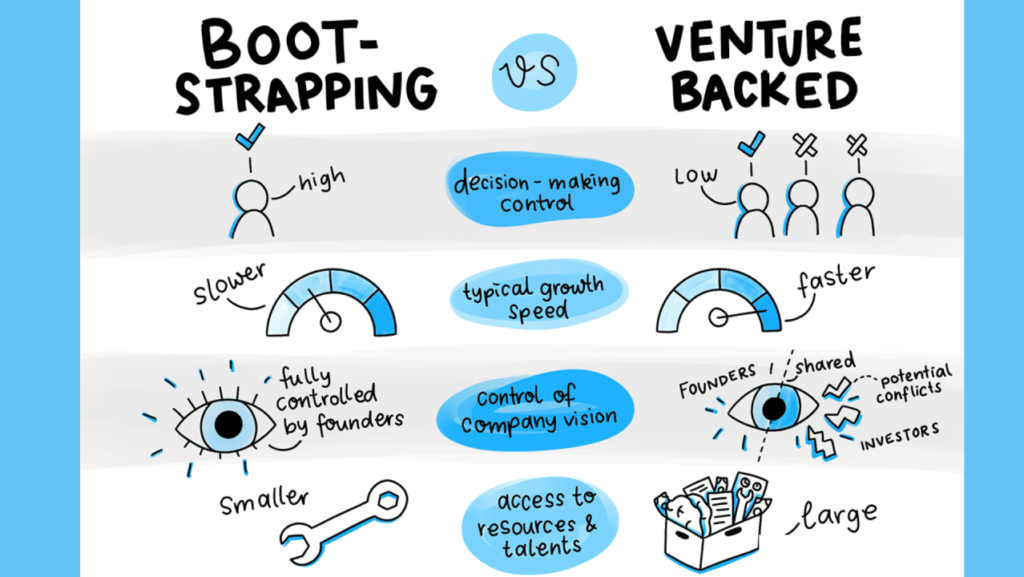
This is genuinely the biggest emotional difference between the two paths.
- Bootstrapped founders retain full decision-making control and ownership
- VC-backed founders answer to a board and investors on major decisions
- Bootstrapping means slower growth but complete autonomy over direction
- VC funding means faster growth but shared control over the company’s future
I’ve noticed founders who deeply value independence often regret taking VC money later, even when the business grows faster, simply because the loss of control feels genuinely uncomfortable.
Which Businesses Suit Bootstrapping Better
Not every business model fits comfortably into either approach. Service-based businesses, consulting firms, and steady-demand local businesses often bootstrap well.
Picture a small accounting firm — steady client revenue funds growth naturally, and there’s rarely a need for the massive capital injection VC provides, since the business model doesn’t require winning a “land grab” against fast-moving competitors.
Which Businesses Suit Venture Capital Better
Tech startups, especially those needing to build market share quickly before competitors do, often genuinely need VC-level capital to compete effectively.
- Businesses with high upfront development costs (complex software, hardware)
- Markets where being first genuinely matters for long-term dominance
- Business models that need significant capital before becoming profitable
- Founders comfortable with high risk and rapid, sometimes uncomfortable, scaling pressure
The Financial Trade-Offs You’re Actually Making
Quick answer: Bootstrapping a startup means keeping 100% ownership but growing at a pace limited by your own revenue and savings, while venture capital provides faster growth capital in exchange for giving up meaningful equity and some control over company decisions.
Neither path is “cheaper” exactly — bootstrapping costs you growth speed, while VC funding costs you ownership percentage and control.
Can You Combine Both Approaches?
Yes, actually, and this hybrid approach is more common than people realize. Many founders bootstrap initially to prove the business model, then raise VC funding once they have genuine traction and negotiating leverage.
This sequencing often results in better funding terms too, since investors pay more for proven traction than for a pure idea. [link to related guide on validating a startup idea here]
FAQ
Q1. Is bootstrapping better than raising venture capital? Neither is universally better — it depends on your business model, growth ambitions, and how much control you’re willing to trade for faster scaling.
Q2. Can a bootstrapped startup eventually raise venture capital later? Yes, many successful startups bootstrap initially to prove their model, then raise VC funding once they have real traction and better negotiating leverage.
Q3. How much equity do founders typically give up in VC funding rounds? This varies, but early-stage founders often give up 15-25% equity in a seed round, with further dilution in subsequent funding rounds.
Q4. Is bootstrapping realistic for a tech startup? It’s harder but not impossible — some tech startups bootstrap successfully by starting with a smaller, profitable niche before expanding more ambitiously.
Q5. Do venture capitalists take over decision-making completely? Not entirely, but they typically get board representation and voting rights on major decisions, meaning founders share significant control over company direction.
Q6. What’s the biggest risk of bootstrapping a startup? Limited capital can mean slower growth, missed market opportunities, or genuine cash flow stress during difficult periods without external funding as a safety net.
Conclusion
Choosing between bootstrapping a startup and pursuing venture capital genuinely comes down to your business model, growth ambitions, and how much control matters to you personally. There’s no universally correct path — just the one that fits your specific situation and goals honestly.
Suggested Alt Text for Images:
- “Founder reviewing bootstrapping versus venture capital options”
- “Startup pitch meeting with venture capital investors”
- “Entrepreneur managing bootstrapped business finances”